venerdì 17 aprile 2015

Random acts of kindness

A random act of kindness is a selfless act performed by a person or people wishing either to assist or to cheer up an individual person or people. The phrase may have been coined by Anne Herbert, who says that she wrote "Practice random kindness and senseless acts of beauty" on a place mat at a Sausalito restaurant in 1982 or 1983. Either spontaneous or planned, random acts of kindness are encouraged by various communities.
International Random Acts of Kindness Week is February 9-15, 2015. People take this week to step out of their normal routine or comfort zone and attempt a new random act of kindness each day of the celebratory week. They post and share their stories, photos, videos and ideas on social media channels.


-Examples of events


  • Caffè sospeso is a tradition in the working-class cafés of Naples where a person who has experienced good luck financially pays for two coffees, but receives and consumes only one, the second being left until a person enquires later whether a sospeso is available.
  • In 2006, the Free Hugs Campaign was made popular by a music video on YouTube.
  • Started in February 2014, the Feed the Deed campaign has inspired over 10,000 random acts of kindness around the world.

venerdì 16 gennaio 2015

New year's resolutions

Happy New Year! These New Year's resolutions are popular every year.


-Popular new year's resolutions
  • Lose weight
  • Volunteer to help others
  • Quit smoking
  • Get a better education
  • Get a better job
  • Save money
  • Get fit
  • Eat healthy food
  • Manage stress
  • Manage debt
  • Take a trip
  • Reduce, reuse and recycle
  • Drink less alcohol
-My new year's resolutions
  • Travel a lot
  • Learn something new
  • Making experiences of life
  • Meet new people
  • Work on one thing a time until finished
  • Save money
  • Be less nervous
  • Spend less time on internet
  • Be organized
  • Enjoy life


Religion symbols


-Jainism
Jainism is a pantheistic religion that teaches non-violence towards all living beings. Its philosophy and practice rely mainly on self-effort in progressing the soul on the spiritual ladder to divine consciousness. Any soul which has conquered its own inner enemies and achieved the state of supreme being is called jina which means conqueror or victor.
Jainism is also called Shraman (self-reliant) Dharma or the religion of Nigrantha (who doesn't have attachments and aversions) by ancient texts.
Jainism was revived by a lineage of 24 enlightened ascetic leaders called tirthankaras culminating with Parshva and Mahavira. In the modern world, it is a small but influential religious group with about 4.2 million followers in India, and growing immigrant communities in North America, Western Europe, the Far East, Australia and elsewhere.
Jains successfully sustained this ancient religion to this era and have significantly influenced and contributed to ethical, political and economic spheres in India. Jains have an ancient tradition of scholarship and have the highest degree of literacy in India; Jain libraries are the oldest in the country. Tamil Jains and Tulu Jains who are native to their region residing in places of Tamil Nadu and Karnataka.


mercoledì 7 gennaio 2015

Palindromes

A palindrome is a word, phrase, number, or other sequence of characters which reads the same backward or forward. Allowances may be made for adjustments to capital letters, punctuation, and word dividers. Famous examples include "A man, a plan, a canal, Panama!", "Amor, Roma", "race car" and "No 'x' in Nixon".
The word "palindrome" was coined by the English playwright Ben Jonson in the 17th century from the Greek roots palin ("again") and dromos ("way, direction").
Palindromes as a form of wordplay have been created for many centuries. For example, the ancient Greeks are known to have often inscribed the following into their fountains:
                                         Nipson anomemata me monan opsin.
 The Romans were also admirers of palindromes, and produced such sentences as:
                                      In girum imus nocte et consumimur igni.

TOP PALINDROMES:

Don't nod
Dogma: I am God
Never odd or even
Too bad – I hid a boot
Rats live on no evil star
No trace; not one carton
Was it Eliot's toilet I saw?
Murder for a jar of red rum
May a moody baby doom a yam?
Go hang a salami; I'm a lasagna hog!
Satan, oscillate my metallic sonatas!
A Toyota! Race fast... safe car: a Toyota
Straw? No, too stupid a fad; I put soot on warts
Are we not drawn onward, we few, drawn onward to new era?
Doc Note: I dissent. A fast never prevents a fatness. I diet on cod
No, it never propagates if I set a gap or prevention
Anne, I vote more cars race Rome to Vienna
Sums are not set as a test on Erasmus
Kay, a red nude, peeped under a yak
Some men interpret nine memos
Campus Motto: Bottoms up, Mac
Go deliver a dare, vile dog!
Madam, in Eden I'm Adam
Oozy rat in a sanitary zoo
Ah, Satan sees Natasha
Lisa Bonet ate no basil
Do geese see God?
God saw I was dog
Dennis sinned

Notizie su: http://fun-with-words.com/

lunedì 1 dicembre 2014

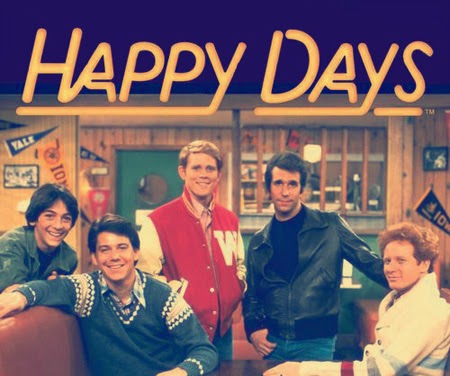
Happy Days

Happy Days is an American television sitcom that aired first-run from January 15, 1974, to September 24, 1984, on ABC. Created by Garry Marshall, the series presents an idealized vision of life in the mid-1950s to mid-1960s United States.
The series was produced by Miller-Milkis Productions and Henderson Productions in association with Paramount Television. Happy Days is one of the highest-rated shows of the 1970s.

It is set in Milwaukee, Wisconsin in the 1950s and 1960s. The series revolves around teenager Richie Cunningham and his family: his father, Howard; traditional homemaker and mother, Marion; younger sister Joanie; and high school dropout, biker and suave ladies' man Arthur "Fonzie"/"The Fonz" Fonzarelli, who would eventually become the Cunninghams' upstairs tenant. The earlier episodes revolve around Richie and his friends, Potsie Weber and Ralph Malph, with Fonzie as a secondary character. However, as the series progressed, Fonzie proved to be a favorite with viewers and soon more story lines were written to reflect his growing popularity, and Winkler was eventually credited with top billing in the opening credits alongside Howard as a result. Fonzie befriended Richie and the Cunningham family, and when Richie left the series for military service, Fonzie became the central figure of the show, with Winkler receiving sole top billing in the opening credits.


lunedì 24 novembre 2014

World Stories: Pandora's Box

Long ago and far away, high up amongst the clouds of Mount Olympus, the Gods enjoyed a life of pleasure and quarrelling. Whenever they tired of quarrelling amongst themselves, they turned their attention to playing with people, as you might play with your toys.
One day, the Gods created a beautiful woman called Pandora and took her to Prometheus. He knew the Gods were angry with him and had stolen fire from them and given it to humans. Prometheus was frightened that the Gods were trying to trick him to get their own back and he decided to ignore her.
However his brother, Epimetheus, fell in love with the beautiful Pandora and decided to marry her. The couple lived happily together until…one day Mercury the messenger of the Gods arrived with a mysterious box. He asked Pandora and her husband to take care of it while he was away. Before he left he made them promise never to look inside it.
For days Pandora could not take her eyes off the box. All the time she wondered what was inside; could it be full of glittering jewels, glamorous dresses and golden coins? Whenever Epimetheus was away and no one was around, Pandora would creep up to the box and run her fingers over the polished wood and the golden clasp. However one day, when Epimetheus was out hunting, she could bear it no longer, her curiosity overcame her. Making sure she was not being watched, she crept up to the box and gingerly opened the clasp. Slowly lifting the lid – she looked inside.
But to her surprise there were no glittering jewels, glamorous dresses, golden coins – instead the Gods had filled the box with all evils now known to mankind. Disease, misery and death swooped and buzzed around stinging her. Pandora screamed and screamed with pain and fear. Epimetheus heard her cries as he rode into the courtyard. Flinging himself from his horse, he ran to her aid, taking her into his arms, he comforted her as the evils flew out of the castle and spread across the land.
Between her sobs Pandora and Epimetheus heard a tiny little voice calling from the box. ‘Let me out!’, ‘let me out!’. Believing that nothing inside the box could be worse than the horrors released, they opened the lid once more.
All that remained was a tiny crumpled butterfly, shivering in the corner – slowly it unfolded its sparkling wings and brushed them against Pandora, healing her wounds. The beautiful butterfly was – hope, which Mercury had hidden amongst the evils, taking pity on mankind when he realised what the Gods were plotting.

venerdì 7 novembre 2014

Guy Fawkes Night

Guy Fawkes was born in April 1570 in York. Although his immediate family were all Protestants, in keeping with the accepted religious practice in England at the time, his maternal grandparents were 'recusant' Catholics, who refused to attend Protestant services. When Guy was eight, his father died and his widowed mother married a Catholic, Dionis Baynbrigge. It was these early influences that were to forge Fawkes' convictions as an adult.
By the time he was 21 his father had left him and gone to Europe to fight for Catholic Spain against the Protestant Dutch republic in the Eighty Years War. His military career went well and by 1603 he had been recommended for a captaincy. He had also adopted the Italian variant of his name, becoming known as 'Guido'.
In the same year, he travelled to Spain to petition the king, Philip III, for support in fomenting a rebellion in England against the "heretic" James I. Despite the fact that Spain and Britain were still, technically, at war, Philip refused.
It was while on campaign fighting for Spain in Flanders that Fawkes was approached by Thomas Wintour, one of the plotters, and asked to join what would become known as the Gunpowder Plot, under the leadership of Robert Catesby.
His expertise with gunpowder gave him a key role in the conspiracy, to source and ignite the explosive. But 18 months of careful planning was foiled with just hours to go, when he was arrested at midnight on 4 November 1605 beneath the House of Lords. Thirty-six barrels of gunpowder were found stacked in the cellar directly below where the king would have been sitting for the opening of parliament the next day. Fawkes was subjected to various tortures, including the rack.
Fawkes was sentenced to the traditional traitors' death - to be 'hanged, drawn and quartered'. In the event, he jumped from the gallows, breaking his own neck and thereby avoiding the horror of being cut down while still alive, having his testicles cut off and his stomach opened and his guts spilled before his eyes. His lifeless body was hacked into quarters and his remains sent to "the four corners of the kingdom" as a warning to others.
Through the centuries the Guy Fawkes legend has become ever-more entrenched, and by the 19th Century it was his effigy that was being placed on the bonfires that were lit annually to commemorate the failure of the plot.