mercoledì 30 aprile 2014

Talent show

A talent show is an event where participants perform talents of singing, dancing, acrobatics, acting, drumming, martial arts, playing an instrument, or other activities to showcase skills, sometimes for a reward, trophy or prize. Many talent shows are performances rather than contests, but some are actual contests, awarding prizes to their participants.
In recent times, talent shows have become a notable genre of reality television, such as Idol, Got Talent and The X Factor, which were critical in catapulting some amateur artists to stardom, and commercially successful careers.

-Britain's Got Talent
Is a British television talent show competition which started in 2007. Anyone of any age with some sort of talent can audition for the show. Acts compete against each other in order to gain the audience support while trying to win the title of "The winner of Britain's Got Talent".
Throughtout the show, contestants must perform in front of the judges and each year initial audition have been held in front of a live audience. Audition precede live shows, where the final 45 contestants perform nightly for a week in order to impress the British and Irish public. The winner of each series is given the opportunity to perform at the Royal Variety Performance in front of members of the British Royal Family, including Queen Elizabeth II. The winner also receives a cash prize of £250,000.


mercoledì 9 aprile 2014

My last weekend

On Saturday morning I didn't go to school because it was raining and at night I came back home at 3:00 a.m. so I was tired and I got up at 11:00 a.m. Then I had a shower, I watched TV and when my parents came back home I ate and after that I washed the dishes.
In the afternoon I slept, again, then I woke up and I got dressed. At 7:00 p.m. my best friend came to my home and we went out with other friends. In the evening I went to St. Justin Irish Pub with Rosalba, my best friend, and Siria.
We ate and danced and at 1:00 a.m. we came back to my home for having a pyjama party. We went to bed at 5:00 a.m.
On Sunday morning we got up at 12:00 p.m. and after an hour and half we started cooking because we were alone, we washed the dishes and we studied.
At 5:00 p.m. we had a shower, we got dressed, we went out and in the evening I went again to the St. Justin with Rosalba because there was the "Serata Salsa".
At 2:00 a.m. we came back home and we went to sleep.


St. George's Day

St George's Day is on April 23rd. It's England's national day.

St. George is the patron saint of England. His emblem, a red cross on a white blackground, is the flag of England and a part of the British flag.
When you think about it, St. George it's a strange choice for an English patron saint. St. Patrick was a missionary in Ireland, but St. George never went to England. He was a Roman soldier who protested against the Romans' torture of Christians and he was tortured and martyred in Palestine. This was because he refused to renounce his Christianity.

One of the best-known stories about St. George is his fight with a dragon. This is hard to believe, but then so is the theory that there aren’t any snakes in Ireland because St. Patrick banished them.

English people tend to spend St. George’s Day at the local pub. "The George and Dragon" is not, however, the most common pub name in England. According to CAMRA, the Campaign for Real Ale, it is "The Crown": according to the BBPA, the British Beer and Pub Association, it is "The Red Lion". By the tradition, 23 April is the day for a red rose in the button hole, the national flower. However, unlike other countries, Englad doesn't celebrate it like Americans celebrate 4 July with fireworks.
In fact, you are more likely to see big St. Patrick's parades in England celebrating Ireland's National Day, more than you would see any sign of St. George's Day being celebrated.


martedì 18 marzo 2014

Irish Culture & Customs

In Ireland people are very cultural orientated no matter what their interests might be. Everyone has some form of traditions that are passed through generations of families.

A typical Irish tradition is probably hundreds of years old and some still seen as a common tradition for many families.
Ireland has dramatically changed over the years leaving behind some of the older traditions. One thing that is not as popular as it once was but is seen as a typical Irish traditions is our blessings. Many of the Irish blessings that are a thing of the past in Ireland are still kept alive by people from all over the world.

A typical Irish traditional wedding is a beautiful ceremony to see or take part in. From the stunning attire of both the bride and groom, traditionally the later would be dressed in a kilt made from the tartan of his clan. The bride would as is done to-day be dressed in a white dress to symbolize her purity.


March 17th marks the day of St Patrick, celebrated by millions of people around the world. In Ireland, St Patrick’s Day was always held as an important religious day to celebrate the teachings of Christianity by St Patrick.


Many family house holds would prepare their homes for Easter Sunday by doing what would be better known as “spring cleaning” to prepare the house for blessing by the local priest which is a religious ceremony that dates back hundreds of years.


Today Halloween is celebrated all around the globe but the Halloween Holiday has its history firmly planted in Ireland. Halloween is also known as Samhain, All Hallows Eve, Hallowmas and Hallowtide. It is celebrated on 31st October but the holiday of Halloween is not just celebrated on the one day any more as the Christian holidays of All Saints Day, November 1st and All Souls Day, November 2nd are celebrated as well.


Most, if not all, Irish families decorate their homes with lights, tinsel and baubles. A Christmas tree is usually erected in the family home on the first day of the holy advent calendar. The tree will be beautifully decorated with an angel on top, presents will layunderneath as seen with many family homes around the world.


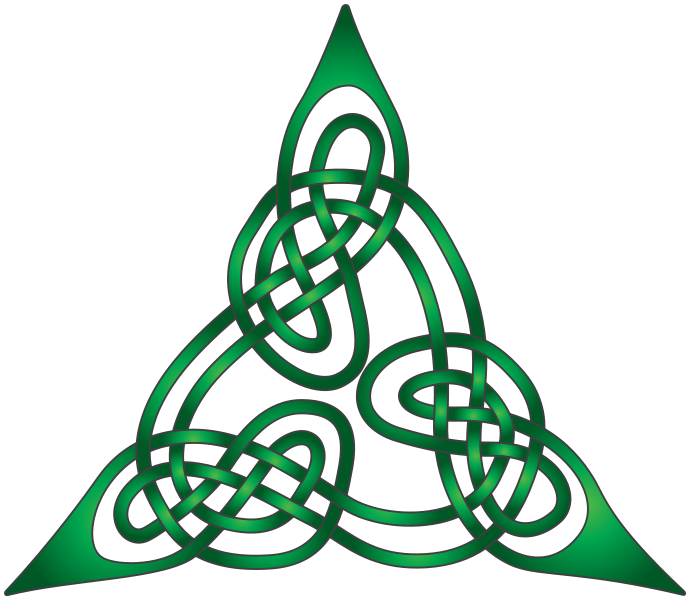
-Celtic knots
Celtic knots are a variety of knots and stylized graphical representations of knots used for decoration, used extensively in the Celtic style of Insular art. These knots are most known for their adaptation for use in the ornamentation of Christian monuments and manuscripts, such as the 8th-century St. Teilo Gospels, the Book of Kells and the Lindisfarne Gospels. Most are endless knots, and many are varieties of basket weaves knots.

-Celtic crosses
Celtic cross is a symbol that combines a cross with a ring surrounding the intersection. It belongs to a kind of crosses with a nimbus. In the Celtic Christian world it was combined with the Christian cross and this design was often used for high crosses. With the Celtic Revival the shape, usually decorated with interlace and other motifs from Insular art, became popular for funerary monuments and other uses, and has remained so, spreading well beyond Ireland.


-Triskele
The triskele is a Celtic and pre-Celtic symbol found on a number of Irish Megalithic and Neolithic sites, most notably inside the Newgrange passage tomb, on the entrance stone, and on some of the curbstones surrounding the mound.


-Leprechaun
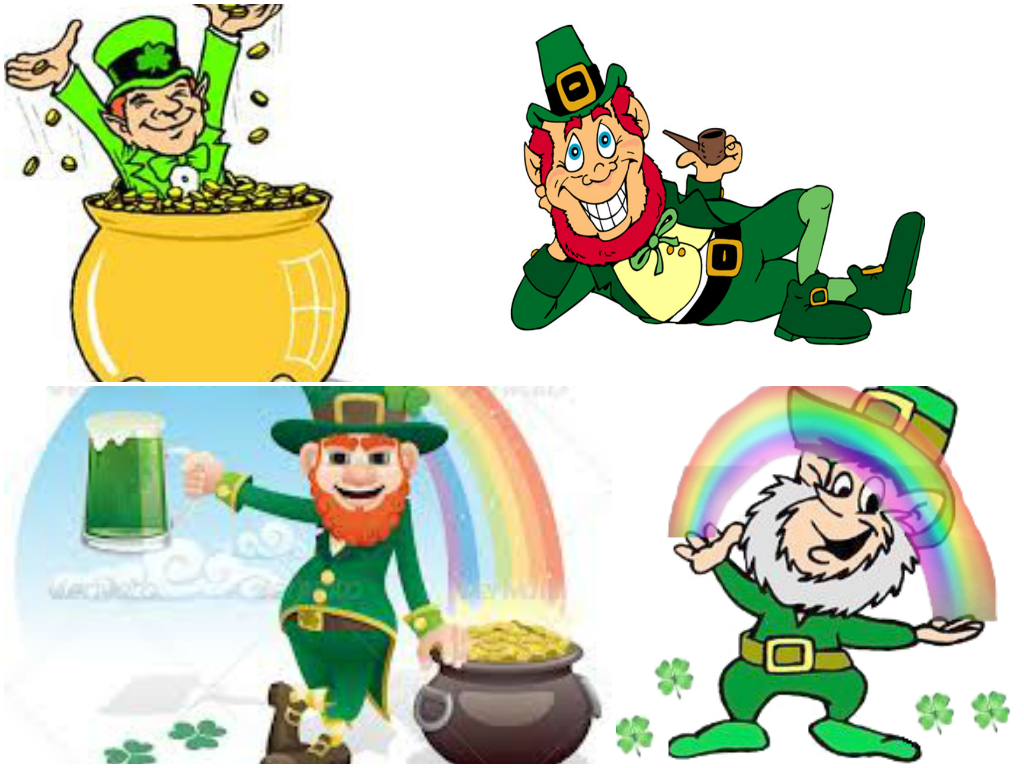
A Leprechaun is a smart, devious little thing and who’ll do anything to escape capture even if it means turning you into a frog. They are shoe-makers. As part of Irish mythology the Leprechauns are part of faerie folk, called by some as the “wee folk”. As a cousin of the clurichaun they are known to inhabited Ireland well before the arrivals of Celtics.
Small enough for one to sit comfortable on your shoulder they are very smartly dressed in small suites with waist coats, hats and buckled shoes.

As mischievous and intelligent folk they are general harmless to the general population in Ireland, although they are known to play the odd trick on farmers and local population of villages and towns.
It is said that every Leprechaun has a pot of gold, hidden deep in the Irish countryside. To protect the leprechaun’s pot of gold the Irish fairies gave them magical powers to use if ever captured by a human or an animal. Such magic an Irish leprechaun would perform to escape capture would be to grant three wishes or to vanish into thin air!


mercoledì 26 febbraio 2014

Presidents' Day

Presidents’ Day is an American holiday celebrated on the third Monday in February. Originally established in 1885 in recognition of President George Washington, it is still officially called “Washington’s Birthday” by the federal government. Traditionally celebrated on February 22 (Washington’s actual day of birth) the holiday became popularly known as Presidents’ Day after it was moved as part of 1971’s Uniform Monday Holiday Act, an attempt to create more three-day weekends for the nation’s workers. While several states still have individual holidays honoring the birthdays of Washington, Abraham Lincoln and other figures, Presidents’ Day is now popularly viewed as a day to celebrate all U.S. presidents past and present.


The story of Presidents’ Day date begins in 1800. Following President George Washington’s death in 1799, his February 22 birthday became a perennial day of remembrance. At the time, Washington was venerated as the most important figure in American history, and events like the 1832 centennial of his birth and the start of construction of the Washington Monument in 1848 were cause for national celebration.

Presidents’ Day is traditionally viewed as a time of patriotic celebration and remembrance. In its original incarnation as Washington’s Birthday, the holiday gained special meaning during the difficulties of the Great Depression, when portraits of George Washington often graced the front pages of newspapers and magazines every February 22. In 1932 the date was used to reinstate the Purple Heart, a military decoration originally created by George Washington to honor soldiers killed or wounded while serving in the armed forces.


Black History Month

Black History Month, is an annual observance in the United States, Canada and the United Kingdom for remembrance of important people and events in the history of the African diaspora. It is celebrated annually in the United States and Canada in February and the United Kingom in October.


The precursor to Black History Month was created in 1926 in the USA, when historian Carter Woodson and the Association for the Study of Negro Life and History announced the second week of February to be "Negro History Week". This week was chosen because it coincided with the Abraham Lincoln's birthday on February 12 and of Frederick Douglass on February 14, both of which Black communities had celebrated together since the late 19th century.


From the event's initial phase, primary emphasis was placed on encouraging the coordinated teaching of the history of American blacks in the nation's public schools. The first Negro History Week was met with a lukewarm response, gaining the cooperation of the Departments of Education of the states of North Carolina, Delaware and West Virginia as well as  the city school administations of Baltimore and Washington DC.

Black History Month sparks an annual debate about the continued usefulness and fairness of a designated month dedicated to the history of one race. Many people hold concerns about black history being delegated to a single moth and the "hero worship" of some of the historical figures often recognized.

martedì 18 febbraio 2014

Carnival in England!☺

Few realise that England has some of the largest annual carnivals in the world. Notting Hill in London is reputedly Europe and possibly the world’s largest, and the Bridgewater Carnival in Somerset the largest illuminated carnival in Europe.


Although it is fairly certain that carnival celebrations date back to the pre-Christian era, modern carnivals come to us from Roman Catholic traditions. Most of Catholic Europe and South America still has a strong carnival tradition, and the best known of all is held in Rio de Janeiro, Brazil, as a holiday during the Christian fast of Lent.


Carnival virtually disappeared in this country with the Reformation, although we still celebrate Shrove Tuesday as Pancake Day and some Shrovetide football matches are still played. As in most Protestant countries, it became a footnote in our history, although a few towns such as Devizes in Wiltshire have parade charters that go back hundreds of years.

Carnival in England has been enlivened over the last forty or so years by the Caribbean influence, and West-Indian style carnivals have received considerable funding and become a popular celebration of our multi-cultural society within the larger metropolitan areas of the country, joined in recent years by Latin American, Asian and Central European communities.


In London, some boroughs still hold summer carnivals, usually involving street parades of floats and individuals in fancy dress costumes, and similar events take place in cities, towns, villages and hamlets throughout England, sometimes at places that barely appear on the map.